
Most med spa advertising advice stops at "run Google and Facebook ads." It skips the parts that decide whether you make money or burn it: what a click really costs, which platform to fund first, why your before-and-after ad keeps getting rejected, and the tracking setup that has cost healthcare providers millions in settlements. This guide covers the paid layer end to end, Google and Meta, with US benchmarks and a source behind every number.
For the full marketing picture, start with our med spa marketing plan and the hub for med spa SEO and marketing. This is the deep dive on advertising.
Google Ads or Meta ads: which should your med spa run first?
Think of the two platforms as capture versus create. Google Search captures demand that already exists: someone typing "lip filler near me" has decided they want it, and you compete to be the one they call. Meta (Instagram and Facebook) creates demand by interrupting someone who was not looking. That gap shows up in lead quality. One agency's illustrative example shows the gap: Google leads booking a consult about 69% of the time and showing up about 86%, versus roughly 35% booked and 70% showed on Meta (ClinicROI). Google costs more per click, but the clicks are worth more.
| Google Search ads | Meta (Instagram + Facebook) ads | |
|---|---|---|
| Job | Capture existing demand | Create new demand |
| Best for | "[Treatment] near me," high-intent | Awareness, new or visual treatments, offers |
| Lead quality | Higher intent, higher cost | Lower intent, lower cost |
| Start here if | Budget is tight | You are launching a treatment or building a name |
If your budget is small and you sell what people already search for (Botox, filler, laser hair removal), fund Google first. Add Meta once Google is profitable and you want to fill the calendar with elective, visual treatments. There is no universal split; the mix depends on your menu, your market, and how well you track revenue by channel.
What med spa advertising actually costs
Here is what no agency homepage admits: there is no clean public dataset of "med spa" ad costs. Every number you have seen is an unsourced agency estimate or a benchmark from an adjacent category. So here is the best sourced data, labeled for what it measures.
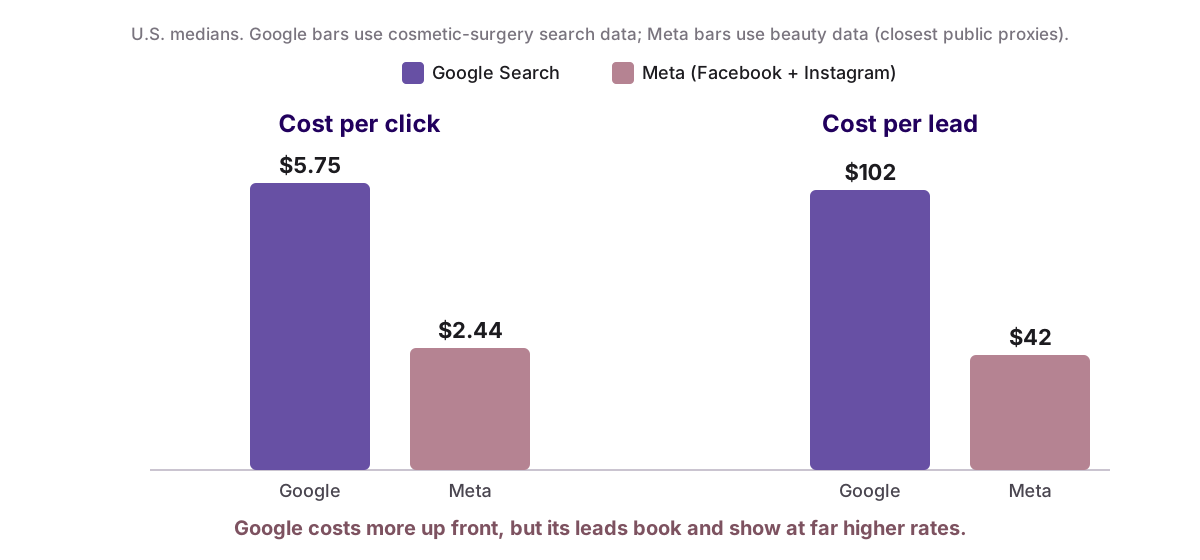
For Google, the strongest dated source is LocaliQ's healthcare benchmarks (3,542 US campaigns, October 2024 to September 2025, reported as medians) (LocaliQ). The closest proxy to a med spa is the Plastic and Cosmetic Surgery row:
| Metric | Plastic and Cosmetic Surgery | Dermatology |
|---|---|---|
| Avg cost per click | $5.75 | $4.90 |
| Avg conversion rate | 8.52% | 25.33% (see note) |
| Avg cost per lead | $102.51 | $18.54 |
That Dermatology conversion rate is a trap. A 25% "conversion rate" almost certainly counts form fills and calls as conversions, not booked, paid consults. A "conversion" in an ad account is a lead, not a patient. Hold that thought.
On Meta, WordStream's Facebook benchmarks put Beauty and Personal Care at about $2.44 per click and $42.10 per lead, and Health and Fitness at about $3.29 and $57.40 (WordStream). Med spa agency Pennock's treatment-level Meta lead costs run roughly $25 to $55 for Botox and $55 to $120 for body contouring (Pennock), which you should read as estimates.
Two caveats. Costs swing hard by treatment and market: "Botox near me" in Miami costs multiples of the same click in a smaller metro. And sources disagree, which is normal for a niche this small, so use them to sanity-check your own account, not as a promise. For total budget, the anchor is about 7% of revenue, ranging 2% to 15% by stage (AmSpa); on ads specifically, plan $2,500 to $4,000 a month to start and more to scale. Below about $1,500 a month you cannot gather enough data to optimize.
Google Ads: capturing "near me" demand
Google works for med spas because of raw local volume. In the US, "Botox near me" gets about 82,000 searches a month, "laser hair removal near me" about 48,000, and "med spa near me" about 28,000, all tagged local and commercial (Ahrefs Keywords Explorer, US, 2026). You can put your name in front of that demand at the moment of intent.
What to get right:
- One campaign per treatment, not a catch-all. "Botox" and "CoolSculpting" are different searchers who need different copy and landing pages.
- A small branded campaign on your own name. Cheap clicks that convert, and they stop a competitor from stealing your name.
- Skip Performance Max at the start. It spends across low-intent placements and hides your search terms. Start on Search, where you control keywords.
- Target tight. Most patients will not drive more than 10 to 15 miles. Target people in your area, not people merely interested in it.
- Lead with phrase and exact match, plus a negative list. Block "jobs," "training," "course," "salary," "DIY," "at home," and "cheap."
Two compliance points trip up med spas, and generic PPC guides miss both.
Local Services Ads are not available to you. Those "Google Screened" ads at the top cover dermatologists and plastic surgeons, but not "med spa" or "medical aesthetics" (Google). If a licensed dermatologist or plastic surgeon owns your practice, that physician may qualify under their own category. The med spa brand itself runs standard Search ads.
Health is a "sensitive category," which kills retargeting. Google's definition of health explicitly includes "cosmetic surgery, surgical procedures, or injections" (Google), so it bars Customer Match (your patient list), lookalike segments, and audience expansion (Google). You can still use keyword targeting and Google's predefined audiences, but you cannot remarket to people who viewed your Botox page, which surprises owners coming from e-commerce. And if you advertise GLP-1 weight-loss injections in the US, Google lets you name prescription drugs like semaglutide in your ads and on your landing page without certification. You only need certification to bid on those drug names as keywords, or if you prescribe them through telehealth (Google).
Send every paid click to a treatment-specific landing page with an offer, provider credentials, reviews, and a booking button plus click-to-call. Never your homepage.
Meta ads: creating demand without getting your account banned
Meta is where most owners get burned, not because the ads fail but because they get rejected, or the whole ad account gets disabled, over creative that looks perfectly reasonable. A med spa is held to Meta's health rules.
Before-and-after photos are the number one cause of rejection, and the nuance matters. Meta's Health and Wellness policy bans weight-loss transformations outright and specifically names "side-by-side comparison after the use of a product or transformation for wrinkles treatment" as not allowed (Meta). It says "general cosmetic" before-and-after is permitted "without employing negative self-perception tactics," so on paper some is fine. In practice, Meta's automated review reads most aesthetic side-by-sides as idealized results and rejects them. The safe play: do not use side-by-side before-and-afters in paid creative at all. Use a single realistic result instead, and keep your before-and-after library for your website and organic social, where you still need written consent (below).
You cannot write copy that assumes you know the viewer's body or condition. Meta's personal attributes policy prohibits ads that imply knowledge of someone's health. Its own examples: "Do you have diabetes?" is banned, but "New diabetes treatment available" is fine (Meta). For a med spa, lead with the service, not the flaw.
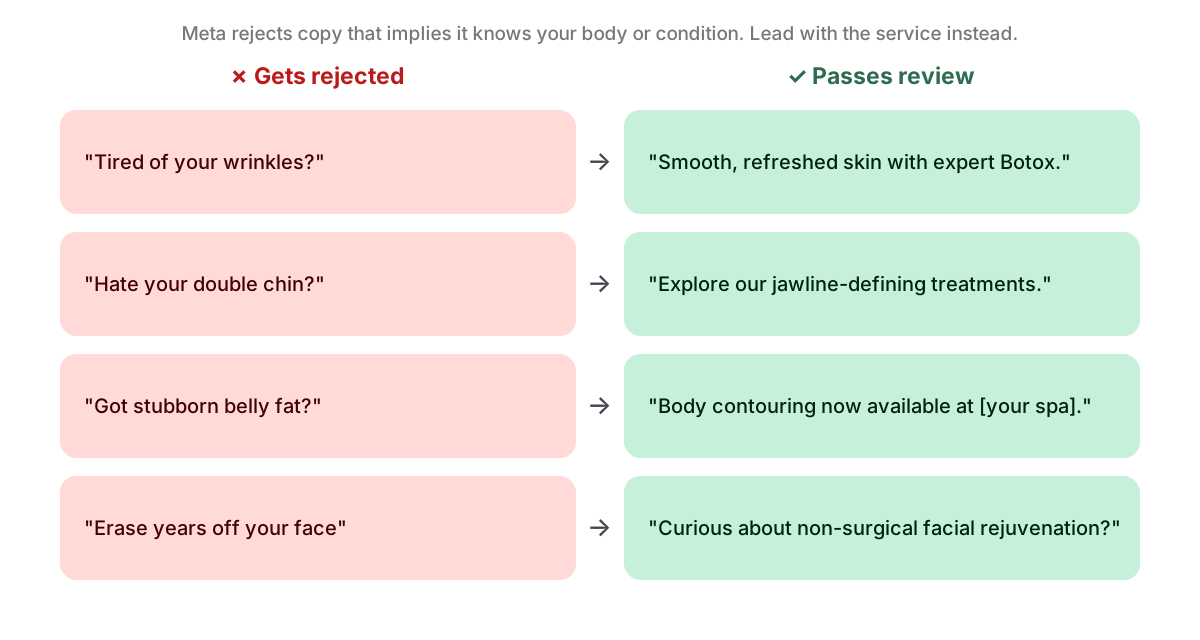
Concretely, "Tired of your wrinkles?" becomes "Smooth, refreshed skin with expert Botox," and "Hate your double chin?" becomes "Explore our jawline-defining treatments." Same offer, no violation. Cosmetic and weight-loss ads must also target people 18 and older, and anything implying a "perfect body" gets rejected.
A point that cuts the other way: a med spa is not a Meta "special ad category." Those are credit, employment, housing, and political issues (Meta). If cosmetic ads were, you would lose age, gender, and ZIP-code targeting and lookalikes, and face a 15-mile minimum radius. Because they are not, you keep precise local targeting. Your real constraints are creative and data, not reach.
On audiences, retargeting website visitors and Instagram engagers is allowed and works well. What you must not do is upload your patient email list as a Custom Audience: that list is a record of people receiving medical treatment, so handing it to Meta raises real HIPAA exposure, and hashing does not cure it (Meta will not sign a Business Associate Agreement). Build audiences from on-platform engagement instead.
The creative that converts within the rules, in rough order:
- A provider on camera explaining a treatment, since credentials build trust and clear review.
- Short "what to expect" education: how it works, downtime, aftercare.
- A single realistic result, never a side-by-side.
- A clear offer with a consultation-first call to action ("Book a consult," not "erase your wrinkles").
Measure cost per booked consult, not cost per click
This is where med spas lose the most money, by optimizing the wrong number. Your ad account shows cost per lead. A lead is not a patient. The funnel between them:
Ad spend, then lead (form or call), then contacted, then consult booked, then showed up, then bought.
Every stage loses people, so the true cost of a patient is far higher than your cost per lead. FoundryCRO's healthcare benchmarks find cost per lead understates true acquisition cost by three to four times. Their example: a $162 cost per lead, at a 60% contact rate, 70% booking rate, 85% show rate, and 70% close rate, lands at about $648 to acquire one patient (FoundryCRO).
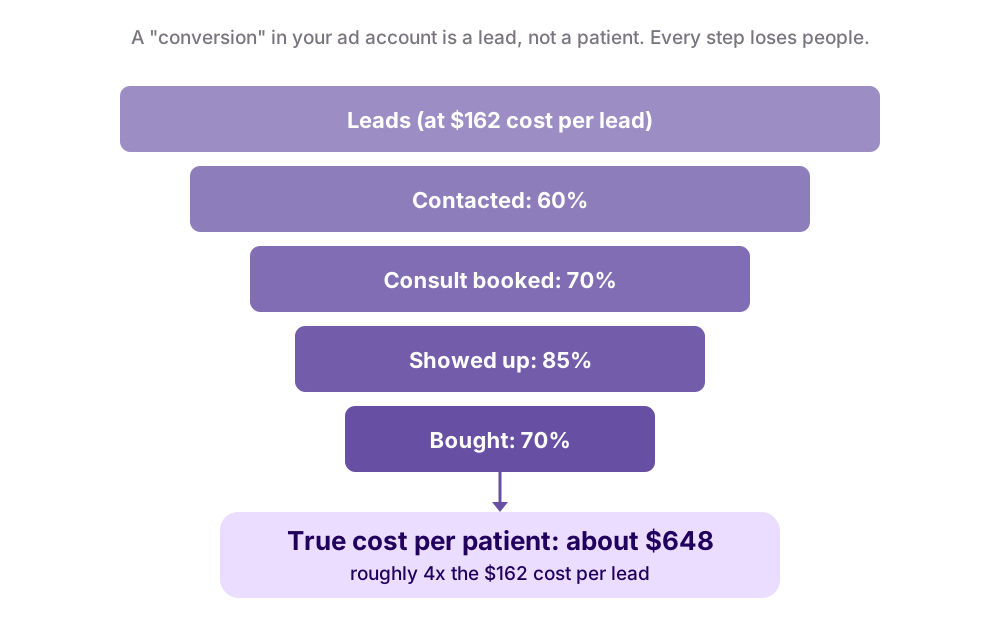
That $648 sounds alarming until you weigh it against lifetime value. A med spa patient is worth roughly $7,200 to $12,000 over time (FoundryCRO's illustration: a Botox client at $600 a visit, three times a year, for five years, about $9,000). So judge campaigns on acquisition cost against lifetime value, not cost per lead in month one. For context, average acquisition cost runs about $285 for a med spa and $610 for cosmetic surgery (First Page Sage).
Two setups are non-negotiable. First, call tracking, because about 88% of healthcare appointments are still booked by phone and click-to-call converts at 25% to 40% versus about 2% for web forms (FoundryCRO). Second, import booked consults back into your ad platforms as the conversion, so Google and Meta optimize toward consults that showed, not cheap clicks. Check that your booking software can pass conversions back; many cannot.
The compliance a med spa cannot skip
A med spa is a medical practice, so its advertising meets medical-advertising standards, not ordinary small-business ones. This is where the expensive mistakes live.
The FTC sets the floor on claims. You need evidence for a health claim before you make it, a testimonial is not that evidence, and "results not typical" does not rescue a misleading before-and-after (FTC). You must also disclose material connections, so an influencer who got free Botox, or a staff member posting a review, has to say so.
The fake-review rule now has teeth. The FTC's Rule on Consumer Reviews and Testimonials took effect October 21, 2024 and carries civil penalties up to $53,088 per violation (the cap is adjusted for inflation each year) (FTC). It bans fake or AI-generated reviews, paying for reviews of a particular sentiment, undisclosed reviews from owners or staff or their relatives, suppressing negative reviews, and buying fake followers. Several common med spa "growth hacks" are now illegal.
Your state medical board may have its own rules. A study reported by the AMA found roughly 36 states have no specific med spa regulations (AMA); where they do exist, the principle is consistent: every claim must be provable. "Our nurses are the best injectors in the state" invites a board to ask for your proof. Check your board on who may perform and medically direct treatments and how they may be advertised. These are US rules; if you operate in Canada, the UK, Australia, or the EU, your advertising regulator and a data-protection law like GDPR impose similar duties.
The tracking trap: do not let your ads leak patient data
Here is the risk absent from every other med spa advertising article, and the one that ends in a lawsuit. The Meta Pixel and Google Analytics tags you install to measure ads quietly send each visitor's data, including their IP address and the pages they viewed, back to Meta and Google. On a medical site, the page someone viewed (a treatment, a "book a consult" form) can itself be health information. Combine that with an identifier and you may be disclosing protected health information to a company with no right to it.
This is not theoretical. Novant Health put the Meta Pixel on its patient portal, disclosed that up to 1.36 million people's data may have gone to third parties including Meta, and settled for $6.6 million (HIPAA Journal). Advocate Aurora settled similar claims for $12.225 million.
Be precise about the law. The HHS Office for Civil Rights issued guidance on tracking technologies; then a federal court in American Hospital Association v. Becerra (June 2024) struck down its most aggressive part (the theory that an IP address plus a visit to a public health page is automatically protected health information), and HHS did not appeal (Holland & Knight). That does not make pixels safe: HIPAA still applies to actual protected health information, logged-in and appointment pages are still in scope, and the lawsuits behind those settlements were never about that one theory. A purely cash-pay med spa that never bills insurance may fall outside HIPAA entirely (Bryant Taylor Law), but state privacy and wiretapping laws and the FTC still apply.
Practically, to work through with your developer and counsel: keep marketing pixels off intake forms, scheduling and confirmation pages, and anything behind a login; prefer server-side tracking (Meta's Conversions API, Google's server-side tagging) where you control which fields leave; never pass names, emails, or treatment details to an ad platform; and get a Business Associate Agreement where required, knowing Google and Meta generally will not sign one for their standard ad products.
Where paid advertising fits
Paid ads are rented traffic: the day you stop paying, the leads stop. Your Google Business Profile, local SEO, and reviews are owned local visibility that keeps booking patients with no per-click cost, which is why acquisition through SEO runs about $215 a patient versus $342 through paid search (First Page Sage). Use paid for speed and to harvest people already searching, but fix your foundation first so your blended cost per patient keeps falling. That foundation is the rest of this playbook: the med spa marketing plan with budget and KPIs, the ranked med spa marketing ideas, plus social media marketing for med spas, email marketing for med spas, and how to run a med spa SEO audit.
Frequently asked questions
How much should a med spa spend on advertising? About 7% of revenue on average, more like 10% to 15% if you are growing fast, with the paid-ad slice starting around $2,500 to $4,000 a month. The better test than any percentage: your cost to acquire a patient should stay well under a third of their lifetime value.
Is advertising worth it for a med spa? Yes, when the math works: keep your cost to acquire a patient well under a third of their lifetime value. If your Google profile and reviews are weak, fix those first by earning strong reviews, because paid clicks that land on a thin profile convert poorly.
Should I start with Google or Facebook ads? Google, if your budget is tight and you sell treatments people actively search for, because the intent is already there and the leads book and show at higher rates. Add Meta for awareness and visual treatments once Google is profitable.
Why do my med spa ads keep getting rejected on Facebook? Almost always one of three things: a before-and-after image, copy that assumes the viewer's flaw ("tired of your wrinkles?"), or messaging that implies an ideal body. Switch to a single realistic result and lead with the service, and the rejections usually stop.
Can I use before-and-after photos in med spa ads? Not safely in paid Meta ads, where side-by-side cosmetic transformations are routinely rejected. Use them on your website and organic social, but only with written patient consent that covers where the photo will appear, and never edited to exaggerate the result.
This is part of our med spa marketing playbook. The hub is med spa SEO and marketing, and the companion pieces are the med spa marketing plan and med spa marketing ideas.
Running ads already, or about to? We will check whether they are tracked to booked consults and whether your booking pages send patient details out, free. Check my ad tracking


