
You are not really asking "is my SEO good." You are asking "why am I not in the top three on Google Maps for Botox in my city." This audit answers that. It takes about an hour, the output is a punch list sorted by impact, and every step names the tool, the check, and the fix. Generic audit guides start with technical trivia; for a med spa, demand is local and the map pack is where the money is, so this starts there. It pairs with the broader med spa marketing plan and the hub at med spa SEO and marketing.
Step 1: Google Business Profile (15 minutes)
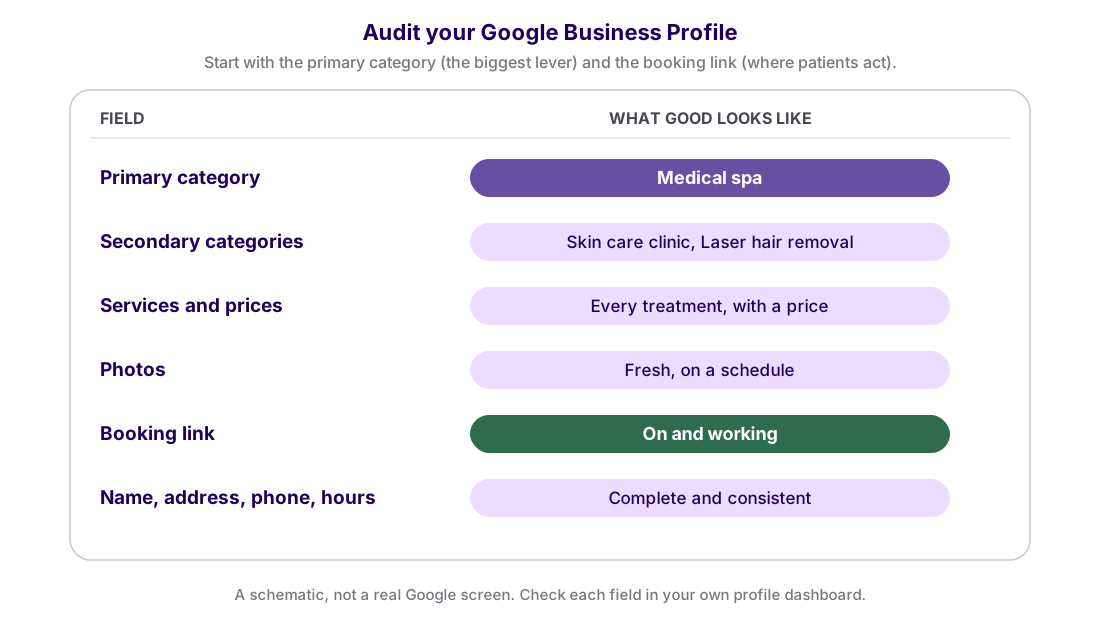
Your Business Profile is the single biggest lever you control. Google ranks local results on relevance, distance, and prominence (Google), and your profile is roughly 32% of local-pack ranking weight (Whitespark). Open it at business.google.com and check:
- Primary category. This is the highest-impact field, and the wrong one is the most common self-inflicted ranking problem. It should be "Medical spa." Many spas are mis-set to "Spa," "Skin care clinic," or "Beauty salon" and quietly lose every aesthetic search. Setting the right primary is the top positive factor; the wrong primary is the top negative one (Whitespark).
- Secondary categories. Add up to nine that match real services ("Skin care clinic," "Laser hair removal service," "Facial spa"), but only for services you actually want leads in.
- Completeness. Fill every field: full address, hours including holidays, phone, website, attributes, opening date, and a real description.
- Services with prices, photos, Posts, Q&A, booking. List each treatment with your own description, refresh photos on a schedule, post weekly, seed and answer real questions, and turn on a working booking link.
A complete, active profile is also a conversion tool, not just a ranking one: most people who find you in the map pack decide straight from the profile, so the photos, services, and booking link are doing sales work, not decoration.
Step 2: Reviews (10 minutes)
Reviews are both a ranking factor (about 16% to 20% of local weight, per Whitespark) and the trust gate for a results-based purchase. Audit them like an asset, against your competitors rather than an absolute number:
- Count vs the spas ranking above you. Aim to match or beat their Google review totals. A controlled test found a noticeable ranking lift once a business clears about 10 reviews (Sterling Sky), so that is the floor, not the goal.
- Recency and velocity. A steady drip beats a stale wall. Whitespark's 2026 study now ranks review recency as the single most important individual local-ranking factor, so build recent-review velocity rather than chasing a big one-time total.
- Average rating. Aim for 4.5 or higher; about 68% of consumers will only use a business rated 4 stars or higher, up from 55% a year earlier (BrightLocal).
- Response rate. Respond to all of them. Confirm no incentivized, staff-written, or fake reviews, which the FTC's 2024 rule bans with penalties up to $53,088 per violation (FTC). The rule is US, but the principle is universal: no fake or undisclosed reviews.
- Keywords in reviews. Reviews that naturally name the treatment and city ("loved my lip filler at [spa] in [city]") help Google connect your profile to those searches. You cannot script reviews, but a quick example in your request nudges it.
Step 3: Map-pack and local visibility (5 minutes)
Now check what you are actually ranking for. Open an incognito window and search your core "[treatment] + [city]" terms. Two truths to internalize:
- Your logged-in result lies. Google personalizes by location, so to diagnose your map-pack visibility across your service area you need a grid or geo-rank view (Local Falcon, BrightLocal, or Whitespark; paid).
- Proximity dominates and you cannot change it. Distance is the single largest map-pack factor (around 55%, Whitespark), so strong rankings near your door that fade across town are expected, not a bug. That is exactly why the levers you do control (the profile, reviews, pages, and citations in the other steps) matter so much. For multiple locations, each needs its own verified profile and its own page.
Step 4: Treatment and location pages (15 minutes)
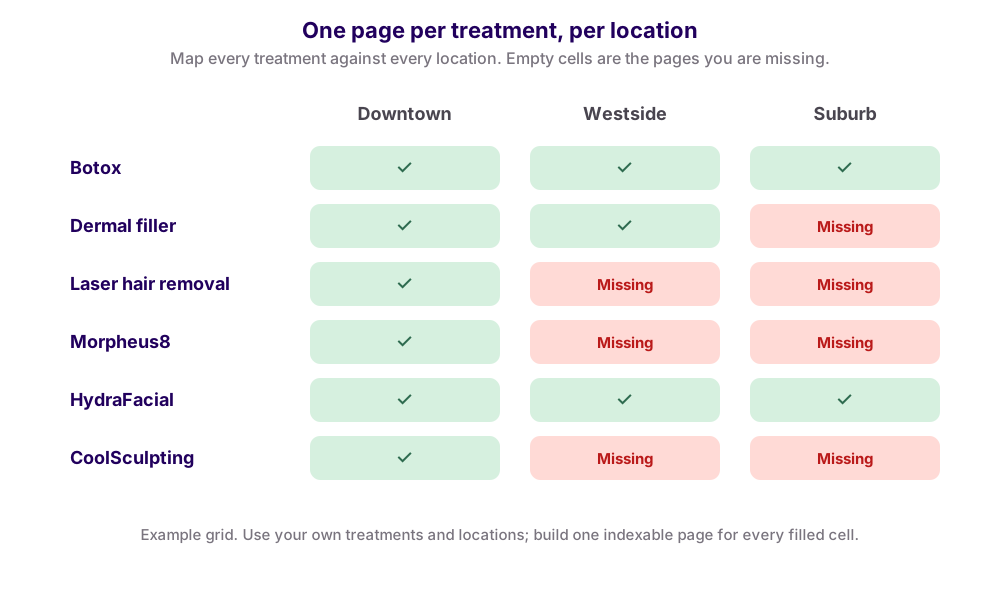
This is the biggest content finding for most med spas. The mistake is one thin "Services" page listing twelve treatments. That page cannot rank for "laser hair removal in [city]." The fix is a dedicated, indexable page for each core treatment, and a dedicated page per location, each with genuinely unique content (never the same copy with the city name swapped, which reads as thin and duplicate) (Search Engine Land). For each page, check:
- It exists and is indexed. Count your real revenue lines against your count of dedicated pages.
- Title and H1 lead with the treatment and city ("Botox in [City]"), not "Our Services."
- Depth and uniqueness. Substantive copy on what the treatment is, who it is for, what to expect, recovery, and pricing context, not boilerplate copied from a device maker.
- Meta description and internal links. Each page needs its own meta description written for the click, not one generic line repeated site-wide, plus links to the hub and to related treatment pages so Google can find and understand it.
A med spa is "your money or your life" content, so Google applies its strictest trust scrutiny. Audit the trust layer generic guides ignore: every clinical page should carry a named, credentialed author or medical director, your About page should show real credentials, and consent-and-disclaimer signals (written before-and-after consent, no guaranteed-result language) double as quality signals on a health site. Get written consent for any patient photo, never promise outcomes, and remember that who may perform and medically direct treatments is governed by your state medical board (a caution, not legal advice; non-US readers, check your own regulator).
Step 5: Technical and schema (10 minutes)
Technical issues mostly prevent ranking rather than drive it, so this sits below the local work, but a page Google cannot crawl, index, or load on a phone cannot rank at all. Check:
- Mobile and speed. Open a core treatment page on an actual phone: is the call or book button visible and tappable on the first screen? Run it through PageSpeed Insights and aim for Core Web Vitals in the "good" band (note INP replaced FID as a Core Web Vital in 2024). Heavy before-and-after galleries and chat widgets are the usual culprits.
- Indexation. In Google Search Console, confirm your treatment and location pages are indexed and not accidentally blocked or noindexed, and that your sitemap lists them.
- Structured data. Use LocalBusiness schema with the most specific type, full address, geo coordinates, phone, hours, and price range (Google).
Step 6: Citations, links, and competitors (5 minutes)
Off-profile authority is a slower lever, so audit it last:
- Citations and NAP. Confirm your name, address, and phone are identical across the big directories and the med-spa-specific ones general guides miss: RealSelf, Healthgrades, and device-maker provider finders (CoolSculpting, Emsculpt, HydraFacial) (American Med Spa Association). Prioritize consistency over raw count, which is not a proven ranking lever.
- Links. Pull your referring-domain count and compare it to two or three competitors; look for local press, partner, and "best med spas in [city]" roundups linking to them but not you.
- Benchmark the spas beating you. For the businesses holding the map pack on your top search, line up their categories, review count and recency, and treatment pages against yours. Their review count is the target to beat, and their page structure shows you which treatment-plus-city pages you are missing. That comparison turns directly into your punch list.
The tools you need (free and paid)
You can run most of this audit for free:
- Google Business Profile dashboard for every profile field, and its Performance tab to see how people find and act on your listing.
- Google Search Console to confirm your pages are indexed and to see which queries each one earns.
- PageSpeed Insights for mobile speed and Core Web Vitals.
- An incognito Google search for a rough rank read, plus your own phone for the mobile check.
Two paid tools are worth it once you are past the basics: a geo-grid rank tracker (Local Falcon, BrightLocal, or Whitespark) to see your true map-pack visibility across the area, and Ahrefs or Semrush for keyword targeting, content gaps, and competitor backlinks.
What to fix first (and when to call for help)
Sort your punch list by impact, not by the order you found things:
- Google Business Profile, especially the primary category and completeness. Cheapest, fastest, the biggest local payoff, often a same-day fix that lifts ranking within weeks.
- Reviews: clear 10, out-pace your nearest competitor on count and recency, and respond to every one.
- Citation and NAP cleanup: a small, reliable lift.
- Treatment and location pages: the biggest content gains, but they take weeks to write well, so start with your highest-revenue treatment in your main city.
- Technical fixes: repair anything that blocks crawling, indexing, or mobile use; treat the rest as hygiene.
- Links: last, built on top of the foundation.
The honest part: the profile and reviews are usually five to ten quick wins an owner can do alone. The treatment pages, schema, geo-grid tracking, and link work are where most owners decide to hand it off. If that is you, that is what we do.
Frequently asked questions
Why is my med spa not showing up on Google Maps? Usually one of three things: the wrong primary category (it should be "Medical spa"), too few or stale reviews compared with competitors, or you are simply outside the searcher's proximity. Work Steps 1 to 3 first.
Can I do my own med spa SEO audit? Yes. The profile, reviews, and map-pack checks (Steps 1 to 3) are free and take about half an hour. The page, schema, and link work in the later steps is where many owners bring in help.
How long does med spa SEO take to work? Profile and review fixes can move the map pack within weeks. New treatment pages and link building compound over months, not days. Anyone promising a specific position by a specific date is guessing.
How often should I run this audit? A full pass quarterly, plus a quick monthly look at your profile, new reviews, and map-pack ranking for your top treatments.
Do I need to add FAQ or schema markup for rich results? Use LocalBusiness schema, yes. But FAQ and HowTo markup no longer produce rich results, and self-applied review markup does not earn star ratings, so do not spend time chasing those.
This is part of our med spa marketing playbook. The hub is med spa SEO and marketing, with the marketing plan, marketing ideas, and med spa advertising alongside it.
Want the audit done for you, with the fixes in order? Send us your med spa and we will run it and send you the results, free. Run this audit on my spa


